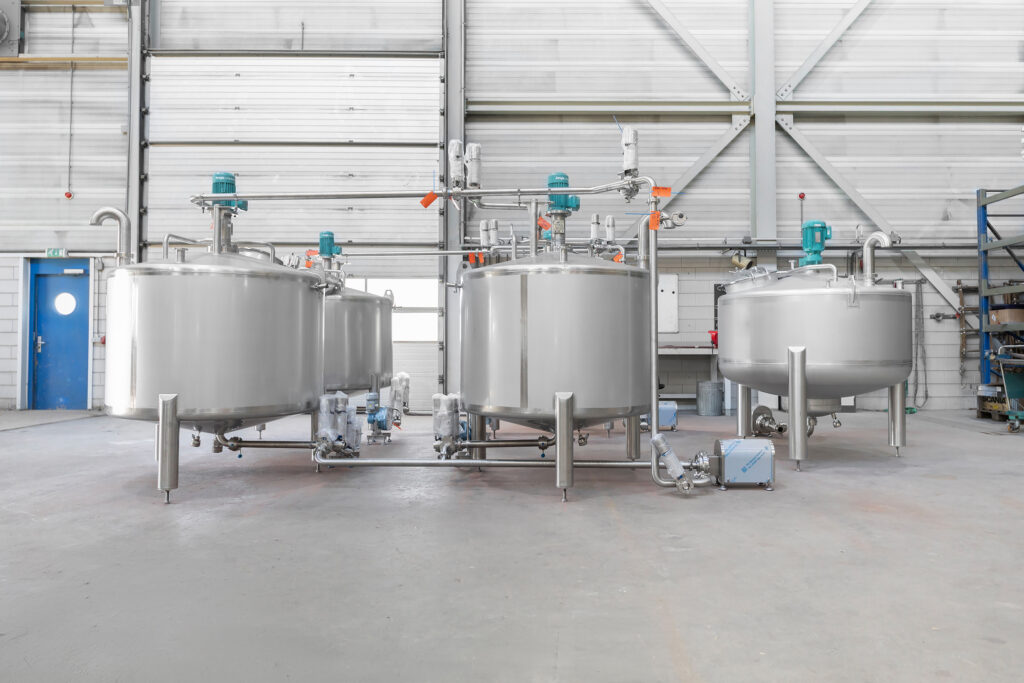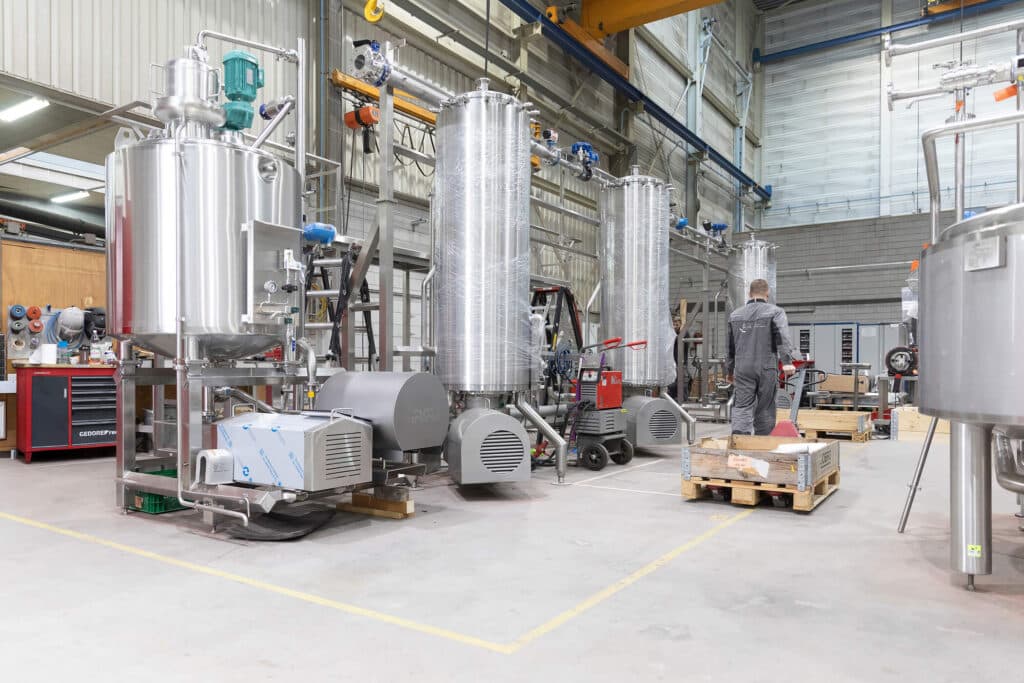



Process vessels come in various sizes and can be used in a wide range of industries. Gpi Process Technology is a manufacturer of stainless steel mixing tanks designed to fit your products and processes. Our mixing tanks start as small as 50 liter but can go up to 10m3 liter or even bigger.
For processes such as mixing, blending, keeping it homogenious, an efficient agitator or a combination of agitators is necessary. Let us know what you would like to achieve, and we will collaborate with you in order to arrive at the most efficient solution.

Do you have questions about the custom process vessel?
Process tank: mixing, blending and homogenisation
Our mixing tanks are designed for optimal process performance in a wide range of applications, such as mixing and blending, homogenisation, emulsification and suspension. By using the right agitator or combination of agitators, a homogeneous end product is achieved in less time, while maintaining product quality and without damaging sensitive ingredients.
Mixing tank specifications
Gpi Process Technology develops and manufactures all agitators in-house, which means we can tailor every mixing solution to the specific viscosity, flow properties and mixing objectives of your product. This ensures maximum efficiency, reliability and flexibility in both standard and complex applications.
Both manual and CIP cleaning possible
We understand that every application is different. That is why our mixing tanks are configurable, ensuring they perfectly match your product and process. Of course, a fully custom-designed mixing tank is also an option. Our mixing tanks are designed with hygiene and cleanability in mind. Depending on your process and industry, our tanks can be easily cleaned manually or with a CIP system.
Custom stainless steel process vessels
Every production environment requires customization. That is why we offer a wide range of custom options, such as heating or cooling jackets, agitators, and measurement and control sensors. This ensures our mixing tanks integrate seamlessly into your existing production line and perfectly match your processing conditions.
- MT50
- MT200
- MT500
- MT1000
- MT2500
- MT5000
- MT7500
- MT10000
- MT125000
- Other sizes are also possible
Soups and sauces | Fruit | Food | ||
| Tomato sauces | Fruit filling | Mashed potato | ||
| Sauces | Cake filling | Mechanically deboned meat | ||
| Dressings | Fruit puree | Ready-to-eat fillings | ||
| Salsa | Jam | Egg | ||
| Hummus | Marmelade | Jelly | ||
| Soup | Fruit sauce | Peanut butter | ||
| Starch slurry | Apple pulp | Pharma | ||
| Spreads | Dairy | Lotions | ||
Confectionary | Milk concentrate | Creams | ||
| Fat cream | Cheese sauce | Wax | ||
| Chocolate | Yoghurt | Toothpaste | ||
| Caramel |
Heated mixing vessels and more
We understand that every mixing tank is different. That is why we design our vessels to be fully customised, ensuring the tank perfectly matches your product and process requirements. Options that can be integrated into your tank include:
- Tiltable design
- Integrated control panel
- Agitators
- Heated (dimple, halfpipe)
- Cooled (dimple, halfpipe)
- Load cells
- Level switches
- Cleaning connections
- Skid-mounted
- Various finishing levels
- Various stainless steel grades (304, 316L, Duplex)
Mixing tank with agitator
An agitator can serve various functions within a process system, depending on the product and the desired processing outcome. For example, an agitator can be used for mixing raw materials, keeping a product homogeneous, or dissolving powders and additives in a liquid. In addition, there are specific applications where the agitator is used for emulsifying, dispersing or suspending, such as with products consisting of multiple phases or containing particles that must not settle.
Processes such as crystallisation, deaeration and improving heat transfer can also be optimised with the right type of agitator. By selecting the appropriate mixing technique, you ensure a more efficient process, more consistent product quality and shorter processing times.

Types of agitators for industrial mixing tanks
Gpi Process Technology designs and manufactures a wide range of agitators for mixing tanks and process vessels, ensuring optimal performance for every application. Depending on the product and process requirements, different types of mixing technologies can be applied, such as gate agitators, anchor agitators, scraping agitators and propeller agitators. For more complex processes, solutions like bottom-driven agitators, screw agitators, side-entry agitators and combinations of agitators are used to achieve efficient mixing, blending and homogenisation.
In addition, Gpi Process Technology offers high-performance technologies such as dispersing disks, rotor/stator systems, turbo mixers and high shear mixers for intensive mixing and particle size reduction. Static mixers and external homogenizers can also be integrated for specific process needs. By selecting the right agitator configuration, or a combination of multiple systems, Gpi Process Technology ensures consistent product quality, improved process efficiency and reliable performance in stainless steel mixing tanks and process vessels.

Food processing tanks finishing levels
As a standard, Gpi ensures a high-finishing level. For some applications, such as in the food industry or even in the pharmaceutical industry, specific requirements are applicable. As a standard, food tanks are produced with an internal roughness of Ra 0.8, but if desired we can also produce tanks with much smoother (and therefore more hygienic) inner walls.

View our other Process Equipment


FAQ
What types of products can be processed in a Gpi Process Technology mixing tank?
Our mixing tanks are suitable for a wide range of products and applications, such as liquid-liquid mixing, powder-liquid applications and viscous products. The tanks are widely used for processes such as mixing, homogenising, emulsifying, dispersing and suspending within the food industry.
Which type of agitator is suitable for my process?
The right type of agitator depends on your product, viscosity and desired process objective. For homogeneous mixing of liquids, a propeller agitator may be suitable, while for viscous products an anchor or gate agitator is more commonly used. Combinations of multiple agitators are also possible when processes such as emulsifying, dissolving or heat transfer need to be combined.